

Aerospace Materials Market Size, Share & Trends Analysis Report 2026- 2035
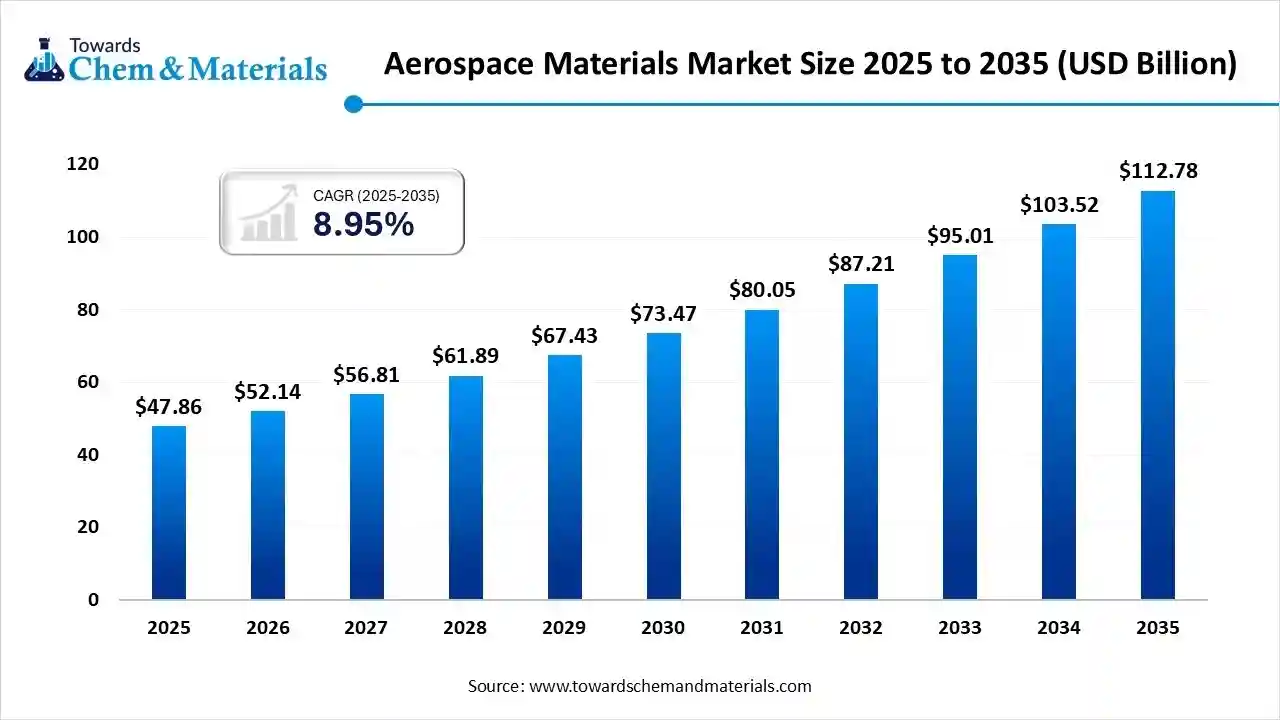
According to Towards Chemical and Materials Consulting, the global aerospace materials market size was estimated at USD 47.86 billion in 2025 and is projected to reach USD 112.78 billion by 2035, growing at a CAGR of 37.11% from 2026 to 2035.
Ottawa, Dec. 05, 2025 (GLOBE NEWSWIRE) -- The global aerospace materials market size reached at USD 47.86 billion in 2025 and is predicted to increase by USD 52.14 billion in 2026 and is expected to be worth around USD 112.78 billion by 2035, exhibiting at a compound annual growth rate (CAGR) of 37.11% over the forecast period 2026 to 2035. Asia Pacific dominated the Aerospace Materials market with the largest revenue share of 37.11% in 2025. The growth of the aerospace materials market in 2025 is being driven by rising demand for lightweight, high-strength, and heat-resistant materials that enhance fuel efficiency, performance, and safety in aircraft and spacecraft. A study published by Towards Chemical and Materials a sister firm of Precedence Research.
Download a Sample Report Here@ https://www.towardschemandmaterials.com/download-sample/6056
What are Aerospace Materials?
The global aerospace materials market encompasses advanced metals, alloys, composites, polymers, and ceramics used in the manufacturing of commercial aircraft, military jets, spacecraft, and satellites. These materials are critical for ensuring structural strength, lightweight performance, thermal stability, and corrosion resistance, all of which are essential for safety, fuel efficiency, and durability in aerospace applications.
Growth in air travel, defense spending, and space exploration initiatives is driving increasing demand for high-performance materials that can withstand extreme conditions. Key segments include carbon-fiber-reinforced composites, titanium alloys, aluminum-lithium alloys, and high-temperature polymers, each selected for specific performance and weight requirements.
Request Research Report Built Around Your Goals: sales@towardschemandmaterials.com
Aerospace Materials Market Report Highlights
- North America dominated the aerospace materials market with the largest revenue share of 37.11% in 2025.
- By type, the aluminum alloys segment led the market with the largest revenue share of 52.66% in 2025.
- By aircraft type, the commercial aircraft segment led the market with the largest revenue share of 42.13% in 2025.
- By application, the exterior segment dominated the market in terms of revenue, accounting for a 49.67% share in 2025.
What is some of the current research in Aerospace Materials at Illinois?
The research being conducted at Illinois in aerospace materials is very diverse. Several projects focus on characterizing experimentally and computationally the constitutive and failure properties of a wide range of materials at various length and time scales, and under a wide variety of loading conditions, from fatigue to impact. Other research projects focus on the development of novel manufacturing techniques, and on the design, manufacture and assessment of biomimetic, multifunctional materials.
Lightweight and High-Performance Materials for Aerospace
The aerospace and defense materials market continues to face unique sustainability and performance-related demands for aviation materials. For over 50 years, Syensqo scientists have worked closely with our customers to develop aerospace composites for some of the most complex and unique challenges in the aerospace industry. Our aircraft materials are delivering the performance and manufacturing requirements of aerospace and defense customers around the world.
With decades of experience as a trusted aerospace materials supplier, our experts continue to innovate and optimize aerospace manufacturing solutions supporting our customers throughout the entire development cycle, from design and certification to production industrialization. Syensqo offers the broadest portfolio in the aerospace market, from composites for aerospace, adhesives, aircraft film, and specialty polymers for fixed-wing aircraft, rotorcraft, aircraft propulsion and systems, space and launch, and advanced air mobility applications.
How Modern Aerospace Materials Are Used in the Industry
For nearly a century, aluminum was the dominant material in aerospace manufacturing, chosen for its light weight, strength and relatively low cost. It defined the first generation of all-metal aircraft and continued to serve as the backbone of aerospace engineering for decades. Today, however, the material mix looks very different.
Modern jets contain significantly less pure aluminum, with many noncritical structures, such as paneling and interior components, replaced by advanced composites like carbon fiber-reinforced polymers (CFRPs) and honeycomb materials.
At the same time, critical components such as engine parts demand metals that can balance lighter weight with the ability to withstand extreme heat and stress. This has led to wider adoption of titanium alloys, high-performance superalloys, and other advanced materials that were once considered too costly or difficult to machine.
For manufacturers and machine shops, these changes bring both challenges and opportunities. Toolmakers and equipment providers must keep pace with evolving material requirements, developing solutions that can handle tougher machining conditions, extend tool life and support efficiency goals across the aerospace supply chain.
Immediate Delivery Available | Buy This Premium Research Report@ https://www.towardschemandmaterials.com/checkout/6056
Aerospace Materials Market Report Scope
| Report Attribute | Details |
| Market size value in 2026 | USD 52.14 Billion |
| Revenue forecast in 2035 | USD 112.78 Billion |
| Growth rate | CAGR of 8.95% from 2026 to 2035 |
| Base year for estimation | 2025 |
| Actual estimates/Historical data | 2018 - 2025 |
| Forecast period | 2026 - 2035 |
| Quantitative units | Volume in kilotons, revenue in USD million/billion, and CAGR from 2026 to 2035 |
| Report coverage | Volume forecast, revenue forecast, company ranking, competitive landscape, growth factors, and trends |
| Regional Scope | North America; Europe; Asia Pacific; Central & South America; Middle East & Africa |
| Country scope | U.S.; Canada; Mexico; Germany; UK; France; Italy; Czech Republic; China; India; Japan; Australia; South Korea; Brazil; South Africa |
| Segments covered | By Type, By Aircraft Type, By Application, By Region |
| Key companies profiled | Avdel , Constellium, Solvay , DOW , Hexcel Corporation, Hindalco - Almex Aerospace Limited , Kaiser Aluminum , KOBE STEEL, LTD , Koninklijke Ten Cate bv. , Lee Aerospace , Materion Corporation , PARK AEROSPACE CORP , Renegade Materials Corporation , SGL Carbon , TATA Advanced Materials Limited , Sofitec Aero, S.L. |
For more information, visit the Towards Chemical and Materials website or email the team at sales@towardschemandmaterials.com| +1 804 441 9344
AI Takes Flight: Revolutionizing the Aerospace Materials Industry
Artificial intelligence is revolutionizing the aerospace materials industry by enabling rapid design, testing, and optimization of high-performance composites, alloys, and polymers. Machine learning algorithms predict material behavior under extreme conditions, reducing development cycles and improving reliability for aircraft and spacecraft components. AI-powered simulations allow engineers to optimize weight, strength, and thermal resistance, supporting fuel efficiency and sustainability goals. Predictive maintenance and real-time monitoring of material performance in service are enhancing safety and lifespan of aerospace structures.
Private Industry Investments in the Aerospace Materials Industry:
- Toray Industries, Inc. has made significant investments in long-term agreements to supply advanced thermoset and thermoplastic composite materials, which are crucial for making lightweight aircraft and space vehicles.
- Hexcel Corporation partnered with Arkema to develop high-performance thermoplastic composite structures, advancing manufacturing efficiency through the Highly Automatized Integrated Composites for Performing Adaptable Structures (HAICoPAS) project.
- Mitsubishi Chemical Group Corporation invests in a vertically integrated portfolio, from carbon fibers to advanced molding solutions, allowing for the delivery of high-strength, fatigue-resistant composites for various aerospace structural components.
- GE Aerospace has invested a total of $44 million in less than two years to expand its Pune, India, manufacturing facility with upgraded automation and precision technology for producing advanced jet engine components from specialized alloys.
-
Aerolloy Technologies (a subsidiary of PTC Industries) formed a long-term partnership with Honeywell Aerospace for the production of titanium and superalloy castings, securing a stable demand for critical metal parts.
Key Trends of the Aerospace Materials Market
- Shift Toward Lightweight Materials The industry is heavily focused on using materials like advanced composites and aluminum-lithium alloys to reduce overall aircraft weight. This weight reduction directly translates to improved fuel efficiency, lower operating costs, and a significant decrease in carbon emissions to meet stringent environmental regulations.
- Increased Adoption of Additive Manufacturing (3D Printing) Additive manufacturing is moving from prototyping to producing flight-critical components, such as engine parts and structural brackets. This technology allows for the creation of complex, optimized geometries with significantly less material waste and shorter production lead times compared to traditional manufacturing.
-
Growing Focus on Sustainability and Recycling There is an increasing demand for eco-friendly materials and manufacturing processes across the supply chain. This includes the development of recyclable thermoplastic composites and bio-based resins, as well as efforts to establish efficient recycling processes for existing composite materials to reduce environmental impact and promote a circular economy.
Market Opportunity
Soaring Opportunities: Advanced Composites Driving the Future of Aerospace
The growing demand for lightweight, high-strength composite materials presents a major opportunity in the aerospace materials market. Airlines and aerospace manufacturers are increasingly adopting carbon-fiber-reinforced polymers, titanium-aluminum alloys, and other advanced composites to reduce aircraft weight, improve fuel efficiency, and lower emissions. Expansion of commercial aviation, the rise of electric and hybrid aircraft, and the growth of space exploration programs are further driving this trend. Innovations in additive manufacturing and nanotechnology enable customized, high-performance components, enhancing operational efficiency and safety.
Immediate Delivery Available | Buy This Premium Research Report@ https://www.towardschemandmaterials.com/checkout/6056
Aerospace Materials Market Segmentation Insights
Type Insights
Which Type Segment Dominates the Aerospace Materials Market in 2025?
The aluminum alloys segment dominated the market in 2025 due to its excellent strength-to-weight ratio, corrosion resistance, and cost-effectiveness, making it ideal for aircraft structures and components. The growing demand for lightweight materials to improve fuel efficiency and reduce emissions in commercial and military aircraft significantly boosted aluminum alloy adoption. Its versatility in forming complex shapes and compatibility with advanced manufacturing processes, including machining and additive manufacturing, further reinforced its preference.
The composite materials segment is expected to grow fastest over the forecast period due to its superior strength-to-weight ratio, corrosion resistance, and design flexibility, which are critical for improving fuel efficiency and performance in aircraft. The rising adoption of carbon-fiber-reinforced polymers, thermoplastic composites, and advanced nanocomposites in commercial, military, and space applications accelerated its demand. Composites enabled manufacturers to reduce aircraft weight while maintaining structural integrity, directly supporting sustainability and emissions-reduction goals.
Aircraft Type Insights
What Made the Commercial Aircraft Segment Dominated the Aerospace Materials Market in 2025?
The commercial aircraft segment dominated the market in 2025 due to the rapid recovery and expansion of global air travel, which increased demand for new and more fuel-efficient aircraft. Airlines and manufacturers prioritized lightweight, high-strength materials such as carbon-fiber-reinforced composites and advanced alloys to reduce fuel consumption and operational costs.
The adoption of next-generation aircraft, including narrowbody and widebody jets with enhanced performance and longer ranges, further accelerated the use of high-performance aerospace materials. Regulatory pressures for emissions reduction and sustainability encouraged the integration of recyclable and eco-friendly materials in aircraft structures and components.
The military aircraft segment is growing fastest over the forecast period due to the growing demand for high-performance, lightweight, and durable materials that enhance speed, maneuverability, and survivability in defense operations. Advanced composites, titanium alloys, and high-temperature polymers were increasingly used in fighter jets, transport aircraft, and unmanned aerial vehicles to improve structural strength while reducing weight. Rising global defense spending and modernization programs across major military powers accelerated the adoption of cutting-edge aerospace materials.
Regional Insights
North America Soars Ahead: Dominating the Aerospace Materials Market in 2025
The North America aerospace materials market size was valued at USD 17.76 billion in 2025 and is expected to reach USD 41.91 billion by 2035, growing at a CAGR of 8.97% from 2026 to 2035. North America dominated the market share 37.11% in 2025.
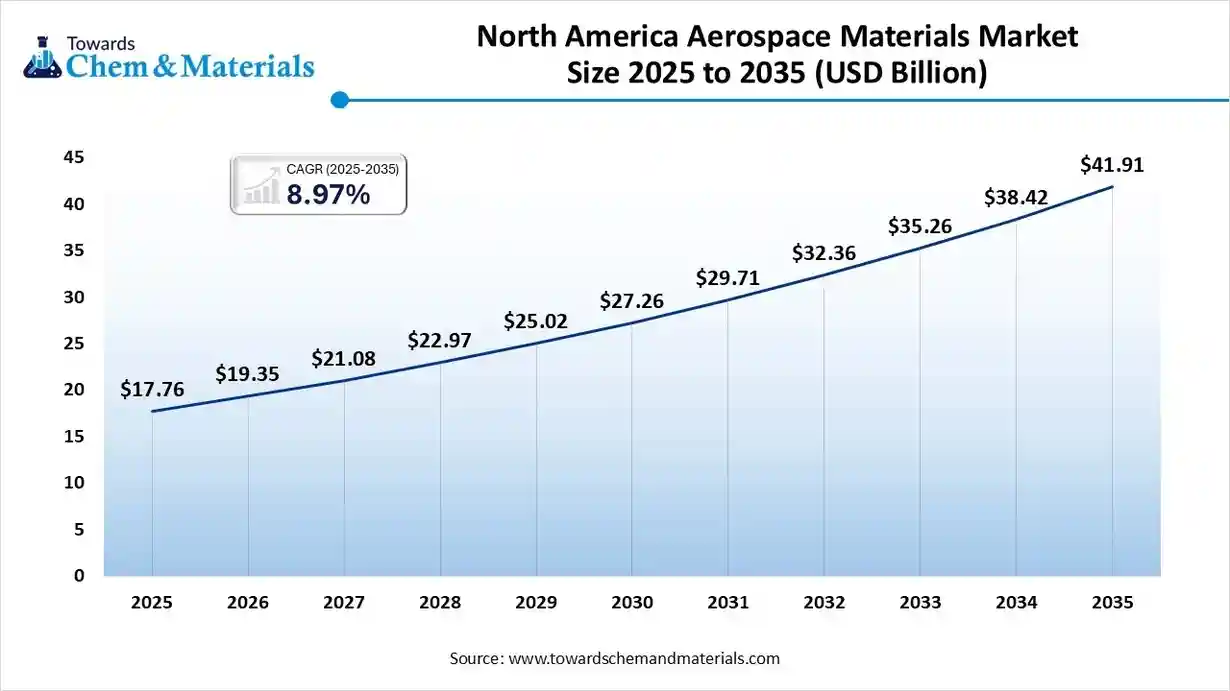
North America dominated the market in 2025, driven by a strong presence of leading aircraft manufacturers, defense programs, and space exploration initiatives. The region's high demand for advanced composites, aluminum alloys, titanium, and high-performance polymers is fueled by commercial aviation growth, military modernization, and increasing adoption of next-generation aircraft technologies. Government support, defense spending, and investments in research and development have accelerated innovation in lightweight, durable, and sustainable aerospace materials.
U.S. Aerospace Materials Market Trend
The U.S. market in 2025 is witnessing steady growth, driven by strong demand from commercial aviation, defense, and space exploration sectors. Increasing air travel and modernization of military aircraft are fueling the adoption of lightweight, high-strength materials such as carbon-fiber composites, aluminum alloys, and titanium. The push for fuel efficiency, reduced emissions, and sustainable aircraft design is accelerating the use of advanced polymers and recyclable materials. Technological innovations, including additive manufacturing, automated composite fabrication, and nanomaterial integration, are enhancing performance and reducing production costs.

Europe Accelerates: Leading the Fastest-Growing Aerospace Materials Market in 2025
Europe emerged as the fastest-growing market in 2025, fueled by increasing demand for lightweight, high-performance materials in commercial aviation, defense, and space programs. Stringent environmental regulations and a strong focus on fuel efficiency and emissions reduction drove the adoption of advanced composites, aluminum alloys, and innovative polymers. Growth in next-generation aircraft, including electric and hybrid models, further accelerated the need for durable and lightweight aerospace materials.
Germany Aerospace Materials Market Trend
Germany’s market in 2025 is experiencing strong growth, driven by the country's advanced aviation, defense, and space sectors. High demand for lightweight, durable, and high-performance materials such as carbon-fiber composites, aluminum alloys, titanium, and advanced polymers is supporting innovations in commercial and military aircraft. Germany's focus on sustainable aviation, fuel efficiency, and emissions reduction is accelerating the adoption of recyclable and eco-friendly aerospace materials.
Top Companies in the Aerospace Materials Market & Their Offerings:
- Avdel: Provides a range of high-performance mechanical fasteners for aircraft assembly.
- Constellium: Offers advanced, lightweight aluminum-lithium alloys for aircraft structures.
- Solvay: Supplies advanced composite materials, polymers, and adhesives for aircraft structures and interiors.
- DOW: Provides silicone-based sealants, adhesives, foams, and de-icing fluids for aerospace applications.
- Hexcel Corporation: Manufactures high-performance carbon fiber, resins, and honeycomb materials for lightweight aircraft components.
- Hindalco - Almex Aerospace Limited: Specializes in hard aluminum alloy billets and slabs used for forging and extrusion in aerospace manufacturing.
- Kaiser Aluminum: Produces custom aluminum sheets, plates, and extrusions for various aerospace applications.
- KOBE STEEL, LTD: Supplies aluminum and titanium alloy products for the aerospace industry.
- Koninklijke Ten Cate bv: Provides advanced thermoset and thermoplastic composite materials for demanding aerospace applications.
- Lee Aerospace: Specializes in manufacturing and refurbishing aircraft transparencies and supplying composite parts.
-
Materion Corporation: Provides advanced beryllium and composite-based alloys used in high-performance aerospace and defense applications.
More Insights in Towards Chemical and Materials:
- Biomaterials Market Size to Surge USD 526.63 Billion by 2034
- Aerospace Plastics Market Size to Worth Around USD 23.28 Bn by 2035
- Aerospace Adhesives and Sealants Market Size to Hit USD 3.66 Bn by 2035
- Aerospace and Defense Materials Market Size to Surpass USD 49.07 Bn by 2035
- Aerospace Foam Market Size to Exceed USD 13.27 Billion by 2034
- Smart Building Materials Market Size to Hit USD 115.85 Bn by 2035
- Circular Construction Materials Market Size to Reach USD 267.14 Billion by 2035
- 3D Printing Materials Market Size to Reach USD 31.23 Bn by 2035
- Advanced Carbon Materials Market Size to Hit USD 86.27 Bn by 2035
- Mycelium-Based Building Materials Market Size to Hit USD 3.81 Bn by 2035
- Cork Building Materials Market Size to Hit USD 20.82 Bn by 2035
- Aerospace and Defense Materials Market Size to Surpass USD 49.07 Bn by 2035
- Advanced Composite Materials Market Size to Surpass USD 102.15 Bn by 2035
- Sustainable Materials Market Size to Hit USD 1078.35 Bn by 2034
- Building & Construction Materials Market Size to Reach USD 3.90 Trillion by 2034
- Building Materials Market Size to Reach USD 2.17 Trillion by 2034
- U.S. Biomaterials Market Size to Surge USD 272.18 Billion by 2034
- Electronic Materials And Chemicals Market Size to Surge USD 136.03 Bn by 2034
- Energy Dense Materials Market Size to Reach USD 211.44 Bn by 2034
- Aluminum Composite Materials Market Size to Reach USD 8.18 Billion by 2034
- High-Temperature Insulation Materials Market size to Reach USD 16.09 Bn by 2034
- Asia Pacific Green Materials Market Volume to Reach 205.45 Million Tons by 2034
- Europe Green Building Materials Market Volume to Reach 406.7 Million Tons by 2034
- U.S. Nanomaterials Market Size to Worth Around USD 14.41 Bn by 2034
- Asia Pacific Battery Raw Materials Market Size to Hit USD 93.11 Bn by 2034
- U.S. Metamaterials Market Size to Surge USD 4,996.74 Million by 2034
Aerospace Materials Market Top Key Companies:
- Avdel
- Constellium
- Solvay
- DOW
- Hexcel Corporation
- Hindalco - Almex Aerospace Limited
- Kaiser Aluminum
- KOBE STEEL, LTD
- Koninklijke Ten Cate bv.
- Lee Aerospace
- Materion Corporation
- PARK AEROSPACE CORP
- Renegade Materials Corporation
- SGL Carbon
- TATA Advanced Materials Limited
- Sofitec Aero, S.L.
Recent Breakthrough in the Aerospace Materials Industry:
In January 2025, a global leader in advanced composite technologies for aerospace applications, Hexcel Corporation exhibit at Aero India 2025, Bengaluru, India. Hexcel heighted its latest innovations in high-performance materials and lightweight materials designed to improve sustainability and efficiency in aerospace applications.
Aerospace Materials Market Report Segmentation
This report forecasts revenue growth at global, regional, and country levels and provides an analysis of the latest industry trends in each of the sub-segments from 2019 to 2034. For this study, Towards Chemical and Materials has segmented the global Aerospace Materials Market
By Type
- Aluminum Alloys
- Steel Alloys
- Titanium Alloys
- Super Alloys
- Composite Materials
- Others
By Aircraft Type
- Commercial Aircraft
- Military Aircraft
- Business & General Aviation (BGA)
- Helicopter
- Other
By Application
- Interior
- Passenger Seating
- Galley
- Interior
- Panels
- Others
- Propulsion Systems
- Airframe
- Tail & Fin
- Windows & Windshields
By Regional
- North America
- Europe
- Asia Pacific
- Latin America
- Middle East & Africa
Immediate Delivery Available | Buy This Premium Research Report@ https://www.towardschemandmaterials.com/checkout/6056
About Us
Towards Chemical and Materials is a leading global consulting firm specializing in providing comprehensive and strategic research solutions across the chemical and materials industries. With a highly skilled and experienced consultant team, we offer a wide range of services designed to empower businesses with valuable insights and actionable recommendations.
Our Trusted Data Partners
Towards chem and Material | Precedence Research | Statifacts | Towards Packaging | Towards Healthcare | Towards Food and Beverages | Towards Automotive | Towards Consumer Goods | Nova One Advisor | Nutraceuticals Func Foods | Onco Quant | Sustainability Quant | Specialty Chemicals Analytics
For Latest Update Follow Us: https://www.linkedin.com/company/towards-chem-and-materials/
USA: +1 804 441 9344
APAC: +61 485 981 310 or +91 87933 22019
Europe: +44 7383 092 044
Email: sales@towardschemandmaterials.com
Web: https://www.towardschemandmaterials.com/


Legal Disclaimer:
EIN Presswire provides this news content "as is" without warranty of any kind. We do not accept any responsibility or liability for the accuracy, content, images, videos, licenses, completeness, legality, or reliability of the information contained in this article. If you have any complaints or copyright issues related to this article, kindly contact the author above.
