

Torpedo Market Set to Reach US$ 3.26 Billion by 2035, Propelled by Fleet Expansions & Advanced Undersea Automation Trend
Torpedo Market
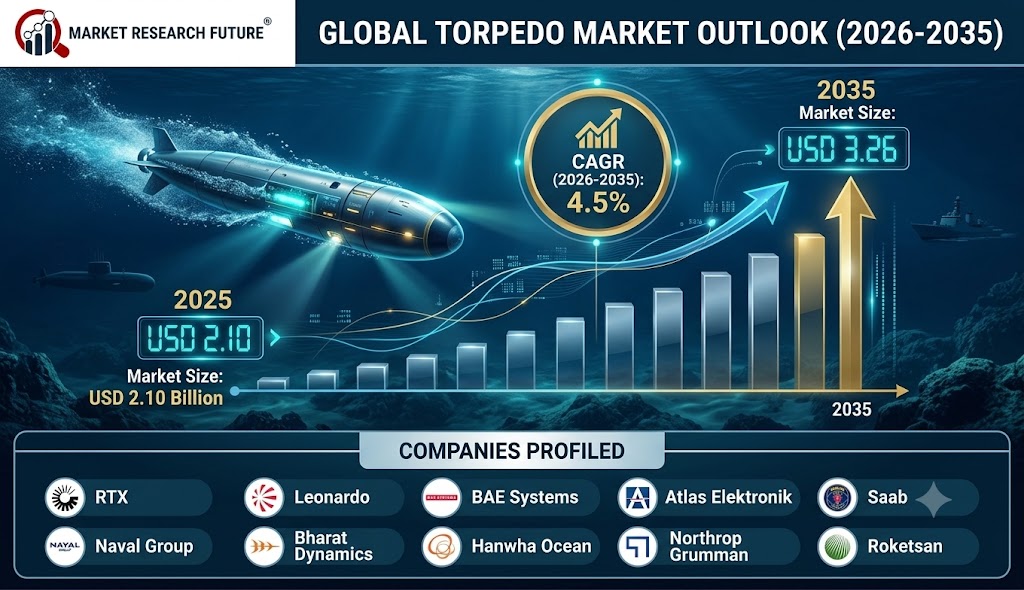
Torpedo Market size stood at USD 2.10 Billion in 2025 and is forecasted to reach USD 3.26 Billion by 2035. This represents a steady CAGR of 4.5% from 2026-2035.
NEW YORK, NY, UNITED STATES, July 18, 2026 /EINPresswire.com/ --The global underwater warfare landscape is undergoing a profound structural shift. Driven by intensive naval modernization programs, expanding submarine fleets, and escalating maritime tensions across critical waterways, the Global Torpedo Market is projected to see steady growth over the next decade.
As maritime nations rapidly invest in cross-domain naval capabilities, the torpedo remains the definitive weapon for both defensive and offensive sub-surface operations. Modern naval doctrines are shifting from legacy standalone hardware toward deeply integrated, multi-role, and network-centric underwater attack systems. This structural transition is creating lucrative long-term opportunities for defense contractors, specialized component manufacturers, and technology investors globally.
Market Drivers:
Accelerated Submarine Fleet Expansion Programs
The primary catalyst driving the global torpedo market is the widespread revitalization and expansion of sovereign submarine fleets. Navies worldwide are shifting their doctrines toward high-intensity undersea deterrence, leading to a surge in the procurement of both nuclear-powered attack submarines (SSNs) and conventional diesel-electric hulls equipped with Air-Independent Propulsion (AIP) systems. Because a single newly commissioned submarine requires a full internal complement of heavyweight torpedoes along with extensive training inventories, these long-term shipbuilding programs provide defense contractors with predictable, multi-year production backlogs. This sustained demand directly ensures steady, structural growth for manufacturers of heavy underwater munitions.
Request Sample of Report: https://www.marketresearchfuture.com/sample_request/6952
Escalating Geopolitical Tensions in Critical Maritime Choke Points
Heightened territorial disputes and strategic rivalries across critical waterways—most notably the Indo-Pacific, the South China Sea, and the Baltic Sea—are forcing rapid defense spending adjustments. Nations are actively fortifying their maritime boundaries to protect vital sea lines of communication and trade corridors from potential sub-surface disruptions. This tense geopolitical environment has shifted naval focus away from low-intensity coastal patrol toward high-end, peer-adversary deterrence, directly accelerating the acquisition and deployment of precision anti-submarine and anti-surface torpedo systems.
Multilateral Defense Collaborations and Technology Transfers
The emergence of specialized, multi-national defense partnerships is significantly lowering technical barriers and opening new procurement streams. Frameworks like the AUKUS agreement, alongside joint development programs within NATO European nations, facilitate the transfer of highly classified underwater warfare technologies between allied countries. These collaborative frameworks streamline the research, development, and eventual manufacturing standardization of next-generation acoustic suites and propulsion systems. By standardizing torpedo components across allied fleets, these agreements create larger, more efficient production runs that drive market volume.
Systematic Modernization and Replacement Cycles of Lightweight Torpedoes
To counter increasingly quiet sub-surface threats, navies are aggressively updating their legacy airborne and surface-launched defensive weapon stocks. Lightweight torpedo configurations are undergoing systematic mid-life upgrades and replacement cycles across NATO and allied Asia-Pacific navies. These modernization efforts focus heavily on retrofitting older hulls, maritime patrol aircraft, and rotary-wing assets with updated digital guidance architectures. This ongoing wave of technology refreshes ensures a continuous stream of modification and sustainment contracts for defense primes.
Key Industry Trends:
Technological Convergence of Torpedo Payloads and Unmanned Underwater Vehicles (UUVs)
A defining trend reshaping undersea warfare is the seamless integration of torpedo combat capabilities into large-diameter Unmanned Underwater Vehicles (UUVs). Modern naval tactics are moving toward hybrid operations where autonomous, uncrewed drones are used to transport, deploy, and launch standard-sized torpedo assets far ahead of the primary fleet. This convergence allows navies to extend their operational striking distance while keeping crewed submarines safely outside high-threat zones. It is forcing defense manufacturers to completely rethink software and physical interfaces to ensure compatibility with unmanned platforms.
Widespread Adoption of Near-Silent Electric Propulsion Systems
The underwater domain places an extreme premium on acoustic discretion, driving a distinct industry pivot away from traditional chemical thermal fuels toward advanced electric propulsion. Utilizing breakthrough energy-density storage solutions, such as modular silver-zinc and safety-optimized lithium-ion battery configurations, modern electric torpedoes can maintain high velocity without producing an expansive thermal or loud acoustic footprint. This transition drastically reduces the target's reaction window, transforming the market as navies mandate near-silent propulsion for shallow-water and littoral operations.
Implementation of AI-Driven Sensor Fusion and Advanced Guidance Systems
As sub-surface targets adopt increasingly complex acoustic countermeasures and hull-silencing designs, torpedo guidance systems must become smarter. Modern weapon architectures are integrating artificial intelligence and advanced digital signal processing (DSP) to enable real-time sensor fusion. By processing inputs from multiple guidance modes simultaneously—such as active sonar pings, passive acoustic signatures, and wake-homing algorithms—next-generation torpedoes can accurately distinguish between actual targets and deceptive acoustic decoys, greatly improving their terminal tracking accuracy.
The Rise of Training-as-a-Service (TaaS) via Digital-Twin Simulations
The astronomical costs and strict environmental regulations associated with live-fire underwater testing have accelerated the adoption of high-fidelity simulation environments. Torpedo manufacturers are building intricate "digital-twin" models of their hardware, allowing navies to run hardware-in-the-loop simulations that perfectly mimic complex underwater scenarios. This operational shift has enabled defense primes to offer "Training-as-a-Service" subscription models. These cloud-based and virtual training environments generate predictable, recurring revenue streams that complement traditional hardware sales.
Market Segmentation Analysis:
The torpedo market is segmented across four primary vectors: Type, Propulsion, Guidance Method, and Launch Platform. Each segment reflects unique technological demands, engineering parameters, and procurement dynamics.
1. By Type: Heavyweight vs. Lightweight Platforms
Heavyweight Torpedoes (HWTs): Standardized around the 533mm (21-inch) diameter form factor, HWTs represent the primary offensive striking power of modern sub-surface fleets. Engineered for anti-submarine warfare (ASW) and anti-surface warfare (ASuW) at extended ranges, these weapons carry heavy explosive payloads designed to break the hulls of large surface vessels and deep-diving nuclear or diesel-electric submarines. HWTs command the largest share of market value due to their extreme complexity, long manufacturing lead times, and the high unit cost of their internal guidance and propulsion subsystems.
Lightweight Torpedoes (LWTs): Typically measuring 324mm in diameter, LWTs are defensive and offensive weapons deployed primarily by surface combatants, helicopters, and fixed-wing maritime patrol aircraft. Their development focuses on quick-reaction deployment, rapid acceleration, and precise shallow-water tracking capabilities. Because they are purchased in larger quantities than their heavyweight counterparts, LWT refresh cycles generate stable, predictable production volumes for manufacturing facilities.
2. By Propulsion: The Shift in Energy Architectures
Electric Propulsion: Driven by advancements in battery chemistry, electric propulsion systems are gaining significant market share. Modern electric torpedoes utilize high-energy-density configurations, such as silver-zinc or advanced lithium-ion variants, to power brushless DC motors or pump-jet propulsors. The primary operational advantage of electric propulsion is its near-silent running signature and independence from depth-related backpressure, making it ideal for stealth operations in littoral waters.
Thermal Propulsion: Utilizing high-energy liquid propellants like Otto Fuel II combined with hydroxylammonium perchlorate, or advanced closed-cycle gas turbines, thermal propulsion remains favored for extreme high-speed and ultra-long-range applications. Thermal systems provide the raw power density required to intercept fast-moving, deeply submerged targets, though they require sophisticated management of exhaust gases and acoustic silencing.
3. By Guidance Method: Precision Undersea Targeting
Wire-Guided Systems: This approach remains a preferred choice for heavyweight submarine-launched torpedoes. By deploying a thin fiber-optic or copper wire behind the torpedo as it travels, the launch platform maintains a high-bandwidth, bi-directional data link. This allows the submarine's sonar suite to transmit real-time targeting updates and counter-countermeasure overrides to the weapon, while shielding the torpedo from early detection by acoustic warning receivers.
Active Homing: Operating via an nose-mounted sonar transducer, active homing torpedoes emit ping sequences to calculate the precise distance, bearing, and closing speed of a target. This method is crucial during the terminal phase of an engagement, ensuring high probability of kill even against evasive targets.
Passive Homing: Designed for stealth, passive homing systems do not emit signals. Instead, they listen for the acoustic signatures generated by a target's machinery, propellers, or hydrodynamic flow. This allows the weapon to execute covert approaches without alerting the target's defensive suites.
4. By Launch Platform: Multi-Domain Deployment Capabilities
Submarines: Submarines serve as the primary platform for heavyweight torpedoes. The ongoing global expansion of both nuclear attack submarines (SSNs) and advanced diesel-electric air-independent propulsion (AIP) submarines acts as a direct driver for this segment.
Surface Ships: Cruisers, destroyers, and frigates utilize onboard torpedo tubes to launch lightweight variants as an immediate defensive screen against incoming underwater threats.
Rotary-Wing Aircraft: Naval helicopters specialize in dipping sonar and sonobuoy deployment, utilizing lightweight torpedoes to prosecute sub-surface contacts quickly over long distances from the parent ship.
Fixed-Wing Aircraft: Maritime patrol aircraft provide long-endurance ocean surveillance and can rapidly drop lightweight torpedoes from internal bomb bays upon detecting deep-sea targets.
Regional Market Share Analysis:
North America - Holding a dominant 38% market share in 2025, North America represents the largest regional market for underwater weapons systems. The segment is anchored by the United States Navy’s extensive sustainment programs for the Mk 48 heavyweight torpedo series and the systematic outfitting of the upcoming Columbia-class ballistic missile submarines. Investment in this geography is heavily skewed toward high-end technology integration, specifically autonomous payload delivery systems and next-generation wideband sonar arrays designed to operate in contested environments.
Europe - Accounting for approximately 28% of the global market share in 2025, Europe remains a hub of technological innovation and manufacturing excellence. Key growth anchors include the production of the UK's Spearfish Mod 1 and the widespread deployment of the German-engineered DM2A4 heavyweight torpedo. Defense funding across Europe is increasingly funneled through multilateral frameworks, such as the Permanent Structured Cooperation (PESCO) underwater defense initiatives, aimed at standardizing anti-submarine warfare inventories across NATO allies.
Asia-Pacific - Identified as the fastest-growing region with a projected CAGR of 5.8% from 2026 to 2035, the Asia-Pacific territory is characterized by intense maritime defense spending. Prompted by evolving security dynamics in the Indo-Pacific, nations including Australia, Japan, South Korea, and India are pursuing domestic submarine construction programs. This has stimulated massive investment in indigenous torpedo development alongside international procurement efforts, making the region a primary target for defense export marketing.
Middle East & Africa - Representing an 8% market share in 2025, this region is experiencing selective naval modernization. Growth is primarily driven by nations executing first-time or expanded submarine acquisition programs, alongside the outfitting of newly acquired surface combatants like corvettes and light frigates with modern lightweight torpedo defensive suites.
South America - Projected to expand at a steady CAGR of 3.9% between 2026 and 2035, the South American market is led by fleet modernization initiatives in Brazil and Chile. The continued expansion and support of the Brazilian Riachuelo-class (Scorpène-based) submarine program serves as the primary regional catalyst for underwater weapons procurement and long-term sustainment spending.
Competitive Landscape: Profiles of Leading Enterprise Participants:
RTX Corporation (USA) - RTX Corporation, through its defense-focused business segments, stands as a cornerstone provider of precision guidance electronics, transducer arrays, and integration architectures for the U.S. military and international allies. The company leverages its decades of missile development experience to implement advanced anti-jamming and signal-processing capabilities into lightweight and heavyweight naval weapon payloads.
Leonardo S.p.A. (Italy) - Leonardo is a global leader in underwater weapons systems, renowned for its Black Shark and Black Arrow heavyweight torpedo series, alongside the widely deployed A244/S lightweight torpedo families. The company's engineering strength lies in its advanced electric propulsion architectures and sophisticated acoustic homing heads, making it a key exporter to navies across Europe, Asia, and South America.
BAE Systems plc (UK) - As the primary prime contractor for the United Kingdom Royal Navy's sub-surface arsenal, BAE Systems manages the advanced Spearfish heavyweight torpedo program and coordinates extensively on lightweight variants like the Sting Ray. The company specializes in full-lifecycle management, complex digital system retrofits, and high-bandwidth fiber-optic guidance telemetry.
Atlas Elektronik GmbH (Germany) - A subsidiary of ThyssenKrupp Marine Systems, Atlas Elektronik is an authority in marine electronics and underwater weapons. Its flagship product, the SeaHake mod 4 (DM2A4), represents a pinnacle of heavyweight torpedo design, featuring modular layout configurations, wake-homing capabilities, and unmatched range profiles suited for both deep ocean and shallow littoral engagements.
Saab AB (Sweden) - Saab occupies a unique position in the market with its specialized focus on shallow-water, highly complex Baltic Sea environments. The Saab Lightweight Torpedo (Torpedo 47) demonstrates the firm’s expertise in optimizing active/passive homing systems and wire-guidance configurations for extremely dense, low-salinity acoustic profiles where traditional sonar tracking faces severe interference.
Naval Group (France) - Naval Group is an integrated European naval defense leader, capable of designing, building, and equipping advanced hull configurations with proprietary weapons systems. Its F21 heavyweight torpedo is engineered to deliver exceptional safety standards for nuclear and conventional vessels alike, featuring an advanced silver-oxide/aluminum battery architecture for high-speed terminal tracking.
Bharat Dynamics Limited (India) - As the manufacturing hub for the Indian Armed Forces' guided weapon systems, Bharat Dynamics Limited (BDL) is scaling its capabilities in the underwater domain. Production focuses on indigenous platforms like the Varunastra heavyweight torpedo and advanced lightweight variants, positioning the firm as a key driver of local sourcing within the South Asian defense ecosystem.
Hanwha Ocean (South Korea) - Formerly Daewoo Shipbuilding & Marine Engineering, Hanwha Ocean provides fully realized naval platforms equipped with complex weapons suites. The company's deep integration expertise ensures that modern heavy and lightweight torpedo systems function cohesively with domestic combat management systems, serving as a primary exporter for the broader Asia-Pacific region.
Northrop Grumman Corporation (USA) - Northrop Grumman delivers high-end technological competencies to the torpedo market, specifically in the production of nose arrays, transducers, and acoustic sensors. The company’s research and development divisions are at the absolute forefront of autonomous underwater system payloads, facilitating the deployment of torpedo-class capabilities from advanced unmanned platforms.
Roketsan A.Ş. (Turkey) - Roketsan has rapidly emerged as an agile, highly capable designer of guided munitions within the NATO alliance. The development of the AKYA heavyweight torpedo and the ORKA lightweight torpedo showcases the company's ability to swiftly design, test, and field modern underwater strike systems, capturing significant market interest across regional modernization initiatives.
Recent Industry Developments:
June, 2026: The Dutch Ministry of Defence officially executed a contract with the French naval defense firm Naval Group to procure F21 heavyweight torpedoes. These advanced, digitally-guided weapons will form the primary organic armament for the Netherlands' upcoming Orka-class diesel-electric submarines.
May, 2026: Science Applications International Corp. (SAIC) secured a contract modification from the U.S. Navy to continue supporting the production, engineering, and hardware repair of the long-standing Mk 48 heavyweight torpedo program. This award ensures the continued integration of technological refreshes into the active American submarine fleet inventory.
February, 2026: ThyssenKrupp Marine Systems (TKMS) and Magellan Aerospace finalized a strategic teaming agreement. The partnership focuses on collaborative production frameworks and comprehensive in-service support for heavyweight torpedo systems, positioning both entities for potential procurement phases of the Canadian Patrol Submarine Project.
Browse More Reports:
Seabed Security Market
https://www.marketresearchfuture.com/reports/seabed-security-market-68274
Aircraft Video Surveillance Systems Market
https://www.marketresearchfuture.com/reports/aircraft-video-surveillance-systems-market-68272
Air Freight Market
https://www.marketresearchfuture.com/reports/air-freight-market-65860
Sagar Kadam
Market Research Future
+1 628-258-0071
sales@marketresearchfuture.com
Legal Disclaimer:
EIN Presswire provides this news content "as is" without warranty of any kind. We do not accept any responsibility or liability for the accuracy, content, images, videos, licenses, completeness, legality, or reliability of the information contained in this article. If you have any complaints or copyright issues related to this article, kindly contact the author above.
